Does it invent our audiences?
It proposes, from what it knows about you. Nothing becomes a persona until a person accepts it.
Who you are talking to, as an audience and the people inside it, held as part of your intelligence so strategy is set against someone real.
Learn next: Strategic Composition · Organizational Intelligence · Business Development
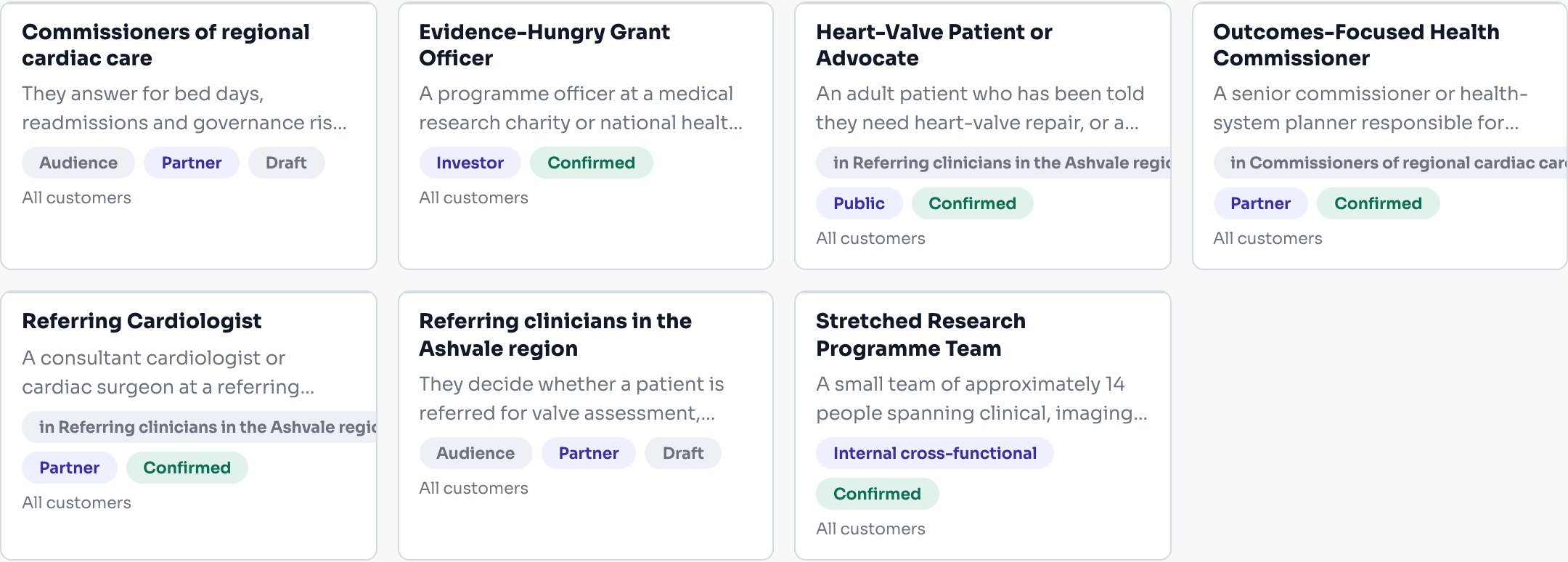
The audiences your organization communicates with, kept as durable records, so nobody restates them in every brief. They sit on a short ladder. At the top is the relationship: a customer, an investor, a partner, a job seeker, your own team, one list of eleven used everywhere. Under it, an audience is a group you address, such as maintenance managers at a chemical site or commissioners of regional care, and a persona is a particular person inside it. Either carries what moves them, what they already believe, and what they need to hear.
The second of the five capabilities is knowing your audience. It is the one most often skipped under deadline, and skipping it is why so much communication is fluent and unpersuasive at the same time.
Personas live in your intelligence base and are available when strategy is set, before any content is composed. Gyrium can propose them from what it already knows about your organization and its market, for you to accept, edit, or reject. When a document you add already describes personas, one by one, Gyrium offers exactly those: one proposal per persona it describes, with every field filled from the document and its relationship (user, buyer, partner, the public) turned into the right register. A persona you already have, by the same name, is not offered again.
Save the group once. Describe an audience, who they are and what they answer for, then hang the people you actually present to underneath it. The library can be read either way round: filter to audiences to see the groups, or to personas to see the people, and a person's card says which audience they belong to. An audience is asked only the questions a group can answer; a person is asked the rest. An audience never sits under another audience, on purpose: a hierarchy of audiences is something every reader would have to walk.
A persona can also say how to speak to them. A deck or a document for investors, or for your own executives, takes that register, while your brand's rules and personality still hold. Every other audience hears your brand voice, and web pages, emails and social posts always speak in it. The brief and the review say which voice a piece is using, and name a persona that has no register yet. Leave the field empty and Suggest drafts three options from the persona's other fields and your brand personality; nothing is kept until you save the persona.
It proposes, from what it knows about you. Nothing becomes a persona until a person accepts it.
No. Add the document under Personas. Each persona it describes is offered as a proposal with its fields filled in, and you accept the ones you want.
Not if the investor persona says how to speak to them. Decks and documents for investors and executives take that register; your brand's rules still hold.
No. They improve the work; they do not gate it.
An audience is the group: the people who answer for the same thing. A persona is one of them, with a name and a register. Save the group once, and stop retyping it into every brief.
Personas are not yet measured against outcomes, so there is no feedback loop telling you which audience framing actually landed. An audience cannot sit under another audience. Only investors and executives take a persona's register in full. Partners and your own team hear the brand voice, and a mixed audience hears it adjusted for each reader. The Brand page does not yet keep rules that hold for every audience apart from the style meant for your main one.
Strategy before words. Gyrium sets the objective, the narrative, and the structure before it composes, grounded in your intelligence base.
The memory of your organization. Everything it knows, captured as sourced facts, structured by a curated taxonomy, and available to everything you make.
Who you are talking to, where each conversation stands and what you owe them next, kept beside the knowledge you would answer them with.
The pilot takes a small number of organizations at a time. Bring what you already have.