Does it just generate text like other AI tools?
No. It decides the strategy first, then composes the content from your sourced knowledge. The writing serves the argument.
Strategy before words. Gyrium sets the objective, the narrative, and the structure before it composes, grounded in your intelligence base.
Learn next: Organizational Intelligence · Brand System & Render Engine · Governance
The way Gyrium produces a communication. It decides the takeaway, the point the piece must make, shapes the narrative that carries it, and sets the structure, and only then composes the content from your sourced knowledge: knowledge, then the takeaway, then the Expression. The pipeline is format-agnostic until the moment it renders, so a proposal and a deck begin the same way.
Writing is no longer the hard part. Knowing what to write is. Prompt-based tools jump straight to words and produce fluent, generic output. Gyrium chooses the strategy first, so the result reads like your best strategist shaped it, and every claim stands on something you already know.
A brief becomes an Expression in defined steps. For a presentation or a document a person signs off twice: once on the thinking, before a word is written, and again on the finished piece, before it is published or shared. The brief itself is grounded on what you have already sourced, so composition draws on knowledge you hold, and anything it cannot source is flagged for the reviewer. What you see in preview is what goes out.
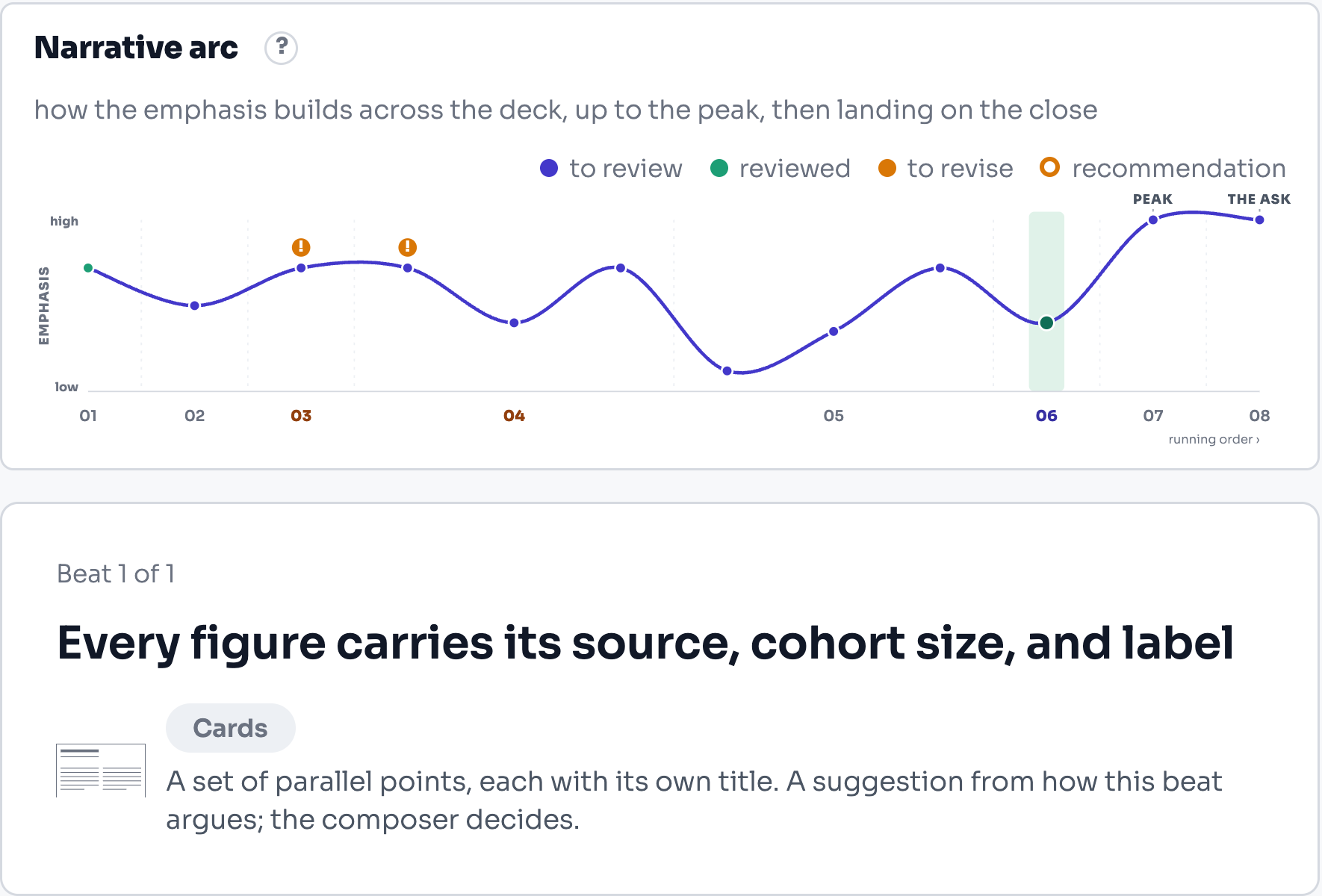
The narrative is where you steer. Before any slide exists you can correct one claim, and only the passages that carry it are rewritten, with a note of what changed. Rewrite a single beat, or add, move or remove one. Removing a beat is final: its notes go with it, and a beat added in its place starts empty. Where the narrative found a gap, add the data, use the fallback it proposes, or drop the point. The brief can be edited from the same place, and a takeaway you rewrote survives a new draft.
The piece comes back the size you asked for. Choose how much text it carries: low, mid or high for slides, light, balanced or dense for documents. Say whether a deck will be presented live or read later as a leave-behind, and the words follow. The slide count you ask for is planned for, cover and closer included, and a short deck drops its section dividers.
You choose how much to steer, first. Detailed walks through the narrative point by point and lets you choose the sources, the layout and the wording. Quick shows the narrative as a short list of what is missing, each with why it matters and what happens if you skip it. Automatic requires nothing and builds from what Gyrium already knows, with no stop at the narrative. You review the finished piece in all three. Your own default is set in Settings, and you can change it for any brief.
The brief is a few short pages: who it is for, what it should say, what this kind of piece needs, the material it draws on, who presents it, and how it is delivered. Beside each answer Gyrium says what it changes in the result, how much (it shapes the whole piece, shapes the argument, or fine-tunes), and what happens if it is left out. Every answer, the fields this kind of piece asks for included, arrives filled in from your sources, and under each one it says whether it was filled from your sources or written by you. Every field is always shown; the ones you may leave are marked Optional, and Gyrium fills what you leave from your sources. Automatic requires nothing at all.
Every piece is written for its own market: the language set on the piece, or else on its project, its customer, and last your organization. An English proposal for an English-speaking customer of a French company follows English conventions. When a figure in a narrative or on a slide cites a fact, Gyrium checks that the figure is in that fact, and it reads each fact in its own language, so 7,49 $ in a French source supports $7.49 in an English deck.
Lines that must not move stay put. Settle the translation of a tagline, a brand promise, a product name or a claim someone signed off, and every piece in that language reproduces it character for character. For the words your trade uses, keep a terminology table per language: your term, and the word to use for it in that language. Saving a pair approves it, and everything written in that language uses your word.
Before sign-off, a slide's checks list what needs attention: more text than the slide should carry, words that contradict the chart beside them, a closer with no contact, a table total that contradicts its own column. Each one is named where it is.
A review also shapes the next piece. When a person has reworked a deck, a document, a web page or an email, Gyrium reads what they changed and proposes what it implies: a word to stop using, a word to prefer, a guideline for how your organization writes, a correction to the fact a passage came from, or a picture to stop offering. It reads changes to the narrative the same way. Nothing is applied until a person ticks it, and a rule you already have is never proposed again. The offer comes at the next narrative approval as well as at sign-off, so the lesson reaches the next piece whether or not the last one was signed off.
To change how new briefs open, go to Settings, then your account, and choose under How you steer a new brief.
To ground a slide in material Gyrium has not read yet, while you review it:
To attach something already read in, choose Use what we have instead.
No. It decides the strategy first, then composes the content from your sourced knowledge. The writing serves the argument.
It composes from the facts in your intelligence base, and flags anything it cannot source. Where a fact is missing, it asks a person to fill it.
Presentations, documents, web pages with forms, emails and social posts.
It proposes what your edits imply, a word to avoid or a standard to keep, and a person decides. Accepted, it applies to the next piece you compose.
For organizations in Canada and Australia, yes. You keep your organization's own approved wording in Settings and choose in the brief whether to include it. It appears after the cover exactly as you approved it.
The strategy stages and review gates are fixed; fully custom pipeline stages are not user-configurable. The review debrief reads decks, documents, web pages and emails; edits to social posts do not yet feed it. A social post is written in your organization's own language, with no choice per post yet. The figure check reads English, Dutch and French number words; in other languages it reads digits.
Win the business
The voice your writing keeps, down to the words you never use.
The people you are writing for, described well enough to write to.
The deck you always reach for, kept as a shape the whole team can build to.
Write it once for one customer. Sell it to the next twenty without pasting anything.
Every piece of work, and the one waiting on you.
The work that is actually waiting on a person.
A person approves the thinking behind a deck or a document, and a person approves the finished piece.
The memory of your organization. Everything it knows, captured as sourced facts, structured by a curated taxonomy, and available to everything you make.
It doesn't export, it renders. Everything you make is assembled from your knowledge and rendered in your design system, element by element.
One source of truth. Sourced, isolated, approved, versioned, exportable, and owned by the customer.
The pilot takes a small number of organizations at a time. Bring what you already have.